


Areas of expertise and information for event organizers - SIMULTANEOUS INTERPRETERS
In view of the ever-increasing international interconnections in politics, economics, science, culture and the media, the conference interpreter provides the indispensable communication bridge between the numerous linguistic and cultural circles amidst small or large meetings of various delegations.
Our pool naturally also includes experienced whispering, consecutive and negotiation interpreters who apply the desired and most appropriate interpreting discipline depending on the requirements.
In the media, work without qualified interpreters is virtually unimaginable. After all, we all want to participate in the daily events of our world, no matter where something momentous is happening, and the television interpreter ensures smooth communication by rendering the message into a language we understand.
Guidelines for event organizers on the use of conference interpreters
At international events, success depends crucially on the quality of the interpreting services. The following information addresses some fundamental questions related to the use of conference interpreters and aims to help create the best possible conditions for effective communication.
1. Types of interpreting
Basically, there are four types of interpreting:
Simultandolmetschen / Simultandolmetscher
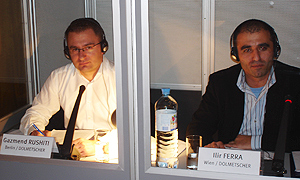
The interpreters sit in a soundproof booth and translate the speaker's words into the target languages simultaneously. Simultaneous interpreters should be hired for larger events, conferences with two or more languages, and meetings where the time delay caused by consecutive interpreting would be too great. Because simultaneous interpreting requires a high level of concentration, the interpreters must be able to take turns every 20 to 30 minutes. Therefore, a sufficient number of interpreters must be available.
Consecutive interpreter / Consecutive interpreter
In consecutive interpreting, the translation takes place after the original text has been spoken. Consecutive interpreting is the appropriate form of interpreting for relatively short speeches (e.g., after-dinner speeches) or for negotiations where the interpreter's presence in the meeting room is essential. With consecutive interpreting, the duration of the event is approximately twice as long as with simultaneous interpreting for each target language.
Whisper interpreting / Flüsterdolmetscher
In whispered interpreting, the interpreter speaks at the same time as the speaker but does not use any special technical equipment. Whispered interpreting is suitable for very small groups, such as during factory tours, but it cannot replace simultaneous interpreting because the original speaker and interpreter speak in the same room at the same time, inevitably leading to interference. Since whispered interpreting requires the same or even more concentration than simultaneous interpreting, two interpreters per target language are also needed for longer events.
Negotiation interpreting / Negotiation interpreter
In negotiation interpreting, shorter passages of text in conversational situations are translated into another language with a time delay and in sections.
2. Hire a conference interpreter
Since the professional title of interpreter is not legally protected, great care must be taken when engaging conference interpreters. Qualified conference interpreters are generally freelancers who work on a contractual basis for their clients.
For the event organizer, it is generally advantageous to engage an experienced conference interpreter (consulting conference interpreter) to handle the assignment of the interpreting team. They know how many interpreters are needed, provide a cost estimate, and engage the interpreters on behalf of the client according to the event's requirements.
A consulting interpreter is also familiar with the requirements for technical equipment used in interpreting and can procure or assist with the procurement of simultaneous interpreting equipment. They are the event organizer's point of contact for all interpreting-related questions and act as a liaison to the interpreting team. The Rushiti Interpreting Agency is happy to assist you with all these matters.
3. Planning the interpreter assignment
A professional interpreter should be involved in the planning of an international event from the very beginning. They can advise the organizer on the planned event schedule from an interpreting perspective and, if necessary, help to avoid unnecessary costs at this early stage.
Conference interpreters should be booked as early as possible (possibly several months before an event). Since the number of qualified interpreters in Germany is limited, shortages often arise during the conference-heavy months of spring and autumn, or when less common languages are involved.
For events with simultaneous interpretation, the number of interpreters required and the composition of the team depend on the number of conference languages, the number of parallel sessions, the duration of the meetings, and the complexity of the topic. Interpreting teams should be structured so that they can interpret directly from all languages into all target languages, and interpreters do not have to indirectly (via relay) translate an already interpreted text into another language.
4. Interpreting and conference technology
Interpreting equipment must comply with ISO/DIS 2603 (for fixed booths) or 4043 (for portable booths). Conference equipment must comply with ENV standard 50185-1 or CEI standard 914. The equipment must be operated by a qualified technician during the event.
The booths should be arranged so that the interpreters have a clear view of the speakers and all projection screens. The speaker's gestures and facial expressions, as well as any images shown, are just as important for the interpreter as they are for the listener. Screens or monitors are, at best, a visual supplement, but no substitute for direct visual contact.
Films and similar presentations can only be interpreted if the interpreter has seen the script before the event and the sound is transmitted flawlessly into the booth.
For copyright reasons, recording interpreted texts generally requires the prior consent of the interpreters and is usually not part of the contracts concluded with the interpreters.
5. Preparing the event
Interpreters must prepare for the subject matter of the events. For this, they need background material such as information about the organizer and other participating organizations, the program, agenda, possibly minutes from previous events and schedules, as well as generally all documents available to the participants.
Interpreters should also have access to lists of participants and, if available, terminology collections, for example with the official translations of names and bodies of organizations, before the event.
If speeches and discussion contributions are prepared in writing by the speakers, they should be made available to the interpreters for preparation.
Sometimes it is also advisable to brief the interpreters beforehand and for the interpreters to participate in speaker meetings.
Conference interpreters are obliged to treat all information confidentially.
6. Speaker
Speakers should be asked by the organizer to submit their manuscripts to the interpreters as early as possible, but no later than two weeks before the event. It is helpful if the manuscript indicates whether it is a final version, a draft, or whether the speaker intends to speak extemporaneously. Any significant changes to texts read aloud should be communicated to the interpreters at the venue. Regardless of whether a speaker speaks extemporaneously or reads from a text, an appropriate speaking pace is important. For texts being interpreted from English into German, for example, the interpreted version is often longer than the original text and requires more time. Eye contact between the speaker and interpreter is beneficial.
Simultaneous interpreting is only possible if the speakers speak into a switched-on microphone, as simultaneous interpreting booths are soundproof. Speakers who move away from the lectern during their presentation should use a lavalier microphone. The organizer should ensure that someone in the hall is specifically responsible for monitoring the proper functioning of the hall's technical equipment.
Numbers and proper nouns should be pronounced especially clearly. Abbreviations should be avoided, or at least explained the first time they appear. Quotations, proverbs, and puns can liven up a speech, but are often difficult to translate into another language.
7. End of the event
Once an event has concluded, a debriefing of the interpreting assignment is recommended. This interaction between the interpreter and the client can reveal any necessary improvements, ensuring continuous quality enhancement to the client's satisfaction. Therefore, a brief meeting with the consulting interpreter after the conference can be beneficial.
RUSHITI & COLLEAGUES
Interpreting agency Berlin
Tel.: 030 – 92215992
Simultaneous interpreter English-German Berlin – English interpreter Berlin // Simultaneous interpreter French-German Berlin – French Interpreters Berlin // Simultaneous interpreter Spanish German Berlin – Spanish Interpreters Berlin // Simultaneous interpreter Italian German Berlin – Italian Interpreters Berlin // Simultaneous interpreter Portuguese German Berlin – Portuguese Interpreters Berlin // Simultaneous interpreter Russian German Berlin – Russian Interpreters Berlin // Simultaneous interpreter Ukrainian German Berlin – Ukrainian Interpreter Berlin // Simultaneous interpreter Polish German Berlin – Polish Interpreters Berlin // Simultaneous interpreter Arabic German Berlin – Arabic Interpreters Berlin // Simultaneous interpreter Vietnamese German Berlin – Vietnamese Interpreters Berlin // Simultaneous interpreter Albanian German Berlin – Albanian interpreter Berlin
Interpreter office Berlin Charlotten-Wilmersdorf | Interpreter offices Berlin Charlottenburg-Wilmersdorf